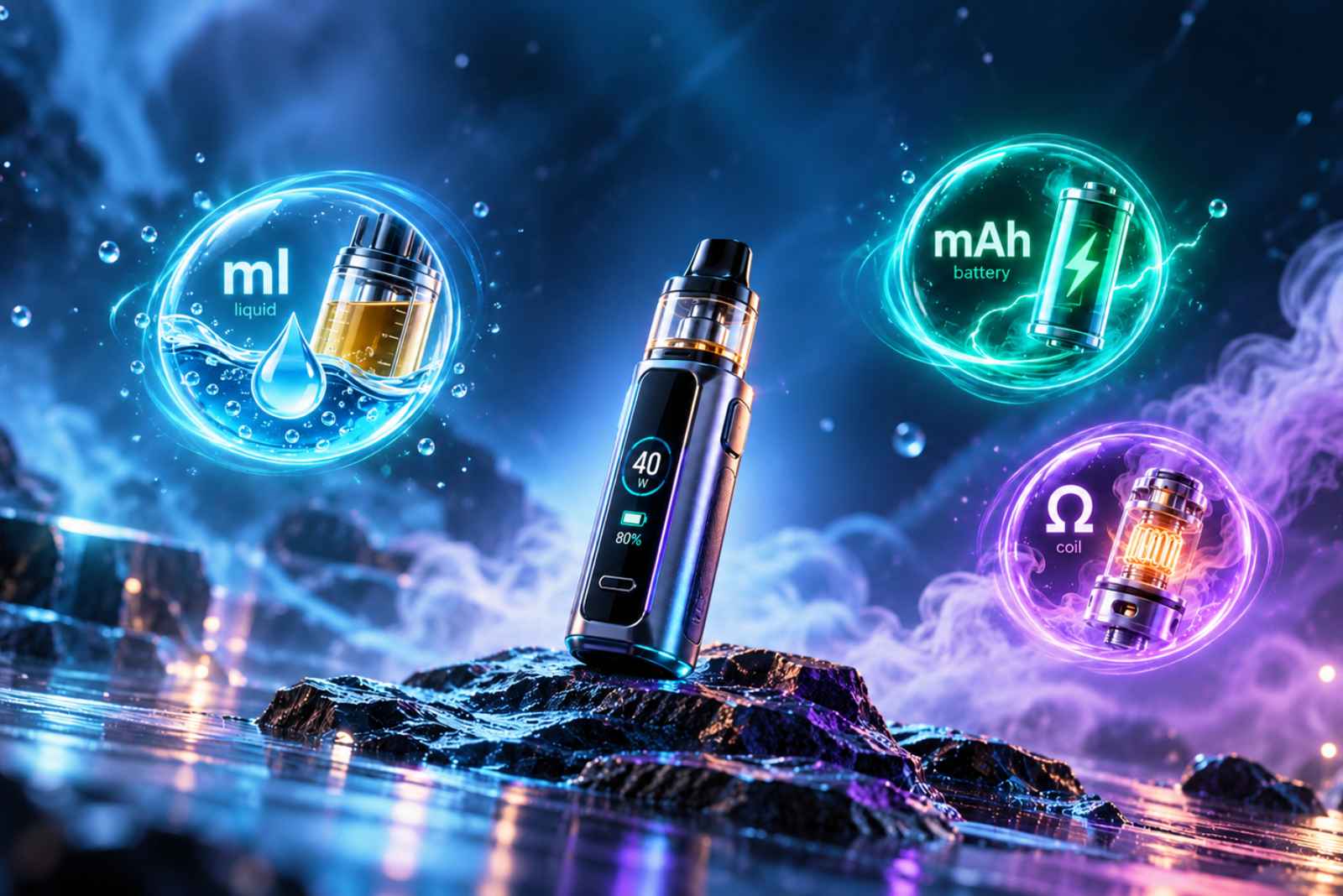
25 ml
1000 mAh
1.0 Ω Mesh Coil
For experienced users, these specifications seem completely normal.
For beginners, however, they can almost look like a little foreign technical language.
What does ml mean?
Is more mAh automatically better?
And what does 1.0 Ω actually tell you about a vape?
That is exactly what we are exploring today.
No complicated electrical engineering.
No unnecessary formulas.
Just three values that can help you understand a modern e-cigarette much better:
ml = how much e-liquid is available
mAh = how much electrical charge the battery can store
Ω = the electrical resistance of the coil
Three small specifications – but three completely different purposes.
Let’s Start with ml: How Much E-Liquid Is Inside the Vape? 💧
ml stands for milliliters.
It is a unit of volume.
In a vape, it usually describes the amount of e-liquid the device contains or can hold.
For example:
10 ml
20 ml
25 ml
40 ml
If a product description says 25 ml e-liquid, it simply means:
The device contains or has a stated e-liquid capacity of 25 milliliters.
That is all this number tells you at first.
And that is exactly why ml is probably the simplest of the three specifications.
More ml Mainly Means More E-Liquid
Imagine two similar vapes.
Vape A:
10 ml
Vape B:
25 ml
If all other conditions were comparable, Vape B would have a significantly larger e-liquid reserve.
This could mean it is generally designed for longer use.
But here comes an important point:
More ml does not automatically mean proportionally more puffs.
Because the actual number of puffs depends on how much e-liquid is vaporized with each draw.
And that can vary.
A short draw consumes less e-liquid than a long one.
A higher-power mode can vaporize more e-liquid.
A different coil can also behave differently.
That is why ml describes the amount of e-liquid.
Not the exact number of puffs you will personally get.
Why Can Two Vapes with 20 ml Have Different Puff Counts? 🔢
That is a very good question.
Imagine this:
Both devices contain 20 ml.
The first is advertised with 15,000 puffs.
The second with 25,000 puffs.
How is that possible?
Because the puff count is not a direct conversion from milliliters.
The manufacturer’s stated figure depends, among other things, on:
how long an assumed puff lasts,
how much power is used,
how much e-liquid is vaporized per draw,
and how the entire device is configured.
That is why you should never think:
1 ml = exactly X puffs.
It does not work that simply.
ml tells you:
How much e-liquid is there?
The puff count, on the other hand, attempts to describe:
How many draws might be possible under certain conditions?
These are two different pieces of information.
Why Is the ml Specification Still Important?
Because it gives you a better understanding of the actual capacity.
Large puff counts naturally look impressive in marketing.
But if you want to compare different vapes, the amount of e-liquid is a very specific technical specification.
For example:
30K Puffs + 25 ml
tells you more than:
30K Puffs
alone.
You do not just see the advertised puff count.
You also know the e-liquid capacity behind it.
That is exactly why it is always worth checking the ml figure when comparing high-puff disposable vape models.
ml Has Nothing to Do with Nicotine Strength
This is sometimes confused.
25 ml does not mean:
25 mg of nicotine.
And 20 ml does not mean:
20% nicotine.
ml describes only the volume of e-liquid.
The nicotine strength is listed separately.
For example:
2% / 20 mg/ml
Here, “ml” appears again, but this time in a different context.
20 mg/ml means:
20 milligrams of nicotine per milliliter of e-liquid.
That is a concentration measurement.
Whereas:
25 ml e-liquid
simply describes the total volume of e-liquid.
Similar units – completely different information.
Now Let’s Look at mAh: How Much Battery Reserve Is Available? 🔋
The second specification looks more technical:
mAh
It stands for:
milliampere-hours.
In a vape, this indicates the electrical charge capacity of the battery.
For example, you might see:
650 mAh
850 mAh
1000 mAh
1500 mAh
To put it very simply, you can think of mAh as a way to describe the size of the battery’s electrical charge reserve.
The higher the mAh rating in comparable devices, the more electrical charge the battery can generally store.
But here, too:
More mAh does not automatically mean a vape will last proportionally longer.
Why?
Because different devices consume different amounts of energy.
A Simple Example of mAh 🔋
Imagine two devices with similar power.
Vape A:
650 mAh
Vape B:
1000 mAh
If both operate under comparable conditions, Vape B generally has a larger battery reserve.
That could mean:
less frequent charging.
But only if energy consumption is similar.
If Vape B also uses:
a larger display,
more power,
multiple coils,
or a stronger Boost Mode,
some of the additional capacity may be offset by higher energy consumption.
That is why mAh should never be considered completely on its own.
mAh Is Not the Same as Watts
This is important too.
mAh describes battery capacity, or stored electrical charge.
Watts describe power.
So a 1000 mAh battery is not automatically:
“more powerful”
than an 850 mAh battery.
It mainly has a larger capacity.
How powerful the vape feels depends on the power the device delivers to the coil.
These are different things.
You can roughly remember it like this:
mAh = how large is the energy reserve?
Watts = how quickly or how intensely is energy being used?
Why Does a High-Puff Vape Need a Rechargeable Battery?
This is where ml and mAh meet for the first time.
Imagine a vape with:
25 ml e-liquid
but only a small, single battery charge.
The e-liquid might be far from empty while the battery has already run out of energy.
A large portion of the e-liquid would then become unusable.
That is why many modern high-puff devices have rechargeable batteries.
This means:
E-liquid available.
Battery empty.
Connect USB-C.
Recharge the battery.
Continue using the remaining e-liquid.
That is exactly why 25 ml of e-liquid and a 1000 mAh battery can work well together, even if the vape needs to be charged several times before all the e-liquid is used.
Does 1000 mAh Automatically Mean 30,000 Puffs?
No.
That is one of the most common misconceptions.
The three figures:
Puffs
ml
mAh
are related, but cannot be directly converted into one another.
A 1000 mAh battery tells you nothing about how much e-liquid is available.
And it does not directly tell you how many puffs the device can deliver in total.
The battery can be recharged several times throughout the device’s lifespan.
That is why a vape can theoretically offer a very high puff count even if its battery is not huge.
The secret is:
Recharging.
Now Comes Ohm: The Most Interesting of the Three Numbers Ω
ml is relatively simple.
mAh becomes understandable with a little explanation.
But Ohm (Ω) leaves many users with question marks.
What does:
1.0 Ω Mesh Coil
mean?
Or:
0.8 Ω?
0.6 Ω?
1.2 Ω?
The Ω symbol stands for Ohm.
Ohm is the unit of electrical resistance.
In a vape, this value describes the resistance of the heating element – in other words, the coil.
And this is where things get interesting.
Because unlike ml or mAh, Ohm does not simply describe “how much” of something is available.
It describes how an electrical component behaves when current flows through it.
What Exactly Is Electrical Resistance? ⚡
Imagine water flowing through a pipe.
A very narrow pipe restricts the flow of water more strongly.
A wider pipe allows water to flow through more easily.
Of course, electrical resistance works differently from a technical perspective – but this comparison helps as a simple way to visualize it.
The coil has a certain resistance to electrical current.
This resistance is measured in Ohms.
That is why a coil may be labeled:
1.0 Ω
This means:
The electrical resistance of this coil is approximately one Ohm.
Nothing more.
Nothing less.
Why Is Ohm Important in a Vape?
Because the coil is an electrical heating element.
The battery supplies electrical energy.
The coil has resistance.
This produces heat.
And that heat vaporizes the e-liquid.
Resistance is therefore directly connected to the technical configuration of the vape.
Together with voltage, power, and coil construction, it influences how the heating system operates.
And that is exactly why 1.0 Ω is not just some decorative number.
It describes a real electrical parameter.
What Does a 1.0 Ω Mesh Coil Actually Mean? 🌀
If a vape is described as having a:
1.0 Ω Mesh Coil
there are actually two pieces of information.
1.0 Ω
This is the electrical resistance.
Mesh Coil
This describes the construction of the heating element – a mesh-like heating structure instead of a traditional simple wire coil.
These two specifications belong together, but they are not the same thing.
You could theoretically have Mesh Coils with different resistance values.
For example:
0.6 Ω Mesh Coil
0.8 Ω Mesh Coil
1.0 Ω Mesh Coil
1.2 Ω Mesh Coil
So Mesh describes the construction.
Ohm describes the resistance.
That is an important difference.
Does Lower Resistance Automatically Mean More Power?
Not automatically.
This is where things can quickly become oversimplified.
In unregulated electrical systems, voltage, resistance, current, and power are directly related.
But modern vapes often contain electronics that control power.
That is why you cannot simply say:
0.6 Ω = always extremely powerful
1.0 Ω = always weak.
Actual performance also depends on the device and its power regulation.
Still, there are general trends.
Lower-resistance coils are often designed for systems that operate at higher power and produce more vapor.
Higher-resistance coils are often used in calmer, more energy-efficient draw systems.
But this is a tendency.
Not a universal rule.
What Does “Sub-Ohm” Mean?
You may have seen this term before.
Sub-Ohm simply means:
below 1.0 Ω.
“Sub” means “below.”
So:
0.8 Ω → Sub-Ohm
0.6 Ω → Sub-Ohm
0.4 Ω → Sub-Ohm
1.0 Ω → not below one Ohm
1.2 Ω → also not Sub-Ohm.
In the past, Sub-Ohm vaping was strongly associated with powerful, large DTL devices.
Today, that distinction is less clear because modern Mesh technology and electronic power regulation allow for many different coil designs.
That is why you should not look at the number alone.
Is 1.0 Ω Good?
The better question is:
Is 1.0 Ω good for this device?
Because a resistance value is not automatically good or bad.
A 1.0 Ω coil can be excellent if the device was designed for it.
A 0.6 Ω coil can also be excellent.
They simply serve different purposes.
With a preconfigured disposable vape, you normally do not have to choose anything at all.
The manufacturer has already matched the:
battery,
electronics,
coil,
and power
to one another.
You mainly read the 1.0 Ω specification to better understand the technology inside the device.
Why Can a 1.0 Ω Coil Be Interesting?
A resistance of around 1.0 Ω is often used in devices designed for a controlled and relatively efficient draw.
This can fit a vaping concept that focuses on:
not maximum power,
but a balanced relationship between flavor, vapor, and energy consumption.
But again:
The number alone does not tell the whole story.
A 1.0 Ω Mesh Coil can behave differently from a traditional 1.0 Ω wire coil.
Why?
Because the construction is different.
Mesh has a different heating surface.
That is why you should always read both specifications together:
Resistance + Coil Type.
Can Ohm Affect Flavor? 🍓
Indirectly: yes.
But not as simply as:
“0.8 Ω tastes better than 1.0 Ω.”
Flavor depends on many technical factors.
The coil influences how the e-liquid is heated.
Resistance is part of this configuration.
But other factors also matter:
power,
heating surface,
e-liquid supply,
temperature,
and device construction.
That is why Ohm is not a “flavor score.”
You cannot say:
0.6 Ω = 10/10 flavor
1.0 Ω = 8/10.
That is not how it works.
Ohm is a technical characteristic, not a quality rating.
Can Ohm Affect Vapor Production? ☁️
Again:
Yes, but only in combination with other factors.
Lower-resistance coils are often operated at higher power and can therefore produce more vapor.
But an electronic vape controls how much power is delivered to the coil.
That is why resistance is only one part of the equation.
Someone buying a ready-to-use disposable vape normally does not need to think about this.
The device has already been configured.
For you, the Ohm specification mainly means:
Now I understand the coil’s electrical characteristics.
Three Numbers – Three Completely Different Stories
Now let’s put everything side by side.
Imagine a fictional vape with:
25 ml e-liquid
1000 mAh battery
1.0 Ω Mesh Coil
What does that tell us?
25 ml
How much e-liquid the device contains.
1000 mAh
The electrical charge capacity of the battery.
1.0 Ω
The electrical resistance of the coil.
This means:
ml = liquid
mAh = battery
Ω = coil
If you remember only these three words, you have already understood almost everything.
Why Shouldn’t You Compare These Numbers Directly?
Because they describe completely different physical quantities.
It would be a bit like comparing the following specifications of a car:
50-liter fuel tank.
70 Ah battery.
2.0-liter engine.
Which number is “bigger”?
The question makes no sense because each specification describes something different.
It is exactly the same with a vape.
25 ml is not “better” than 1000 mAh.
1000 mAh is not “more powerful” than 1.0 Ω.
All three numbers answer different questions.
How to Read a Vape Product Page in Ten Seconds 👀
Imagine a product page says:
30,000 Puffs
25 ml E-Liquid
1000 mAh rechargeable battery
1.0 Ω Mesh Coil
You can now immediately interpret it:
30K → manufacturer’s maximum advertised puff count
25 ml → e-liquid capacity
1000 mAh → battery capacity
1.0 Ω → coil resistance
Mesh → coil construction
Suddenly, the product description no longer looks so technical.
You are no longer reading a foreign language.
You simply see the different characteristics of a device.
Why Are ml and Puffs Not the Same Thing?
Once again, because this point is really important.
ml is a measurable volume.
Puffs are a measure of usage.
That means:
25 ml is 25 ml.
But 30,000 puffs can vary depending on draw length and usage.
That is why the ml specification is often especially helpful when comparing different high-puff vapes.
It shows you the actual e-liquid capacity.
Why Are mAh and Puffs Not the Same Thing Either?
Because a battery can be charged multiple times.
A vape could theoretically have:
a 1000 mAh battery
and a large amount of e-liquid.
After some use:
Battery empty.
But e-liquid still available.
You recharge.
Then continue.
That is why the same vape can consume much more energy over its entire lifespan than its battery can store in a single charging cycle.
The mAh rating only tells you:
How large is one battery charge?
Not:
How much energy will be used throughout the vape’s entire lifespan?
And Why Doesn’t Ohm Tell You How Long a Vape Will Last?
Because Ohm describes resistance.
Of course, coil efficiency can influence energy and e-liquid consumption.
But you cannot take:
1.0 Ω
and directly calculate:
“This vape will last exactly 18,642 puffs.”
Far too much information is missing.
You would need, among other things:
operating power,
draw length,
e-liquid consumption per draw,
battery charging cycles,
and other technical specifications.
For an ordinary user, that would be completely unnecessary.
So it is enough to understand:
Ohm helps you understand the coil’s technical characteristics.
Can You Have 1.0 Ω Without Mesh?
Yes.
Ohm and Mesh are independent of each other.
A coil can have a resistance of 1.0 Ω without being a Mesh Coil.
That is why:
1.0 Ω
is not the same as:
1.0 Ω Mesh Coil.
The first specification describes only the resistance.
The second describes:
resistance + construction.
That is exactly why you should not confuse these two terms in product descriptions.
Can You Simply Say “Ohm Coil”?
You can talk about the Ohm value of a coil.
For example:
“The coil has a resistance of 1.0 Ω.”
Or:
“The resistance is 1.0 Ohm.”
But “Ohm” is not the name of a coil type.
Mesh is a type of coil or heating structure.
Ohm is a unit of measurement.
So:
Mesh = What kind of heating structure?
Ohm = What electrical resistance?
That is probably the most important technical distinction in this entire article.
Why Is the Ω Symbol Used?
The Greek symbol:
Ω
is the international symbol for Ohm.
So you can write:
1.0 Ω
or:
1.0 Ohm
Both mean exactly the same thing.
On vape packaging, the symbol is usually used because it is short and internationally understood.
So the next time you see:
0.8Ω
you will know:
It is not about e-liquid.
Not about the battery.
Not about nicotine.
It is about the resistance of the coil.
Does an Ordinary Disposable Vape User Really Need to Understand Ohms?
Not necessarily.
You can use a ready-to-use vape without ever knowing what Ohm means.
The device already takes care of the technical configuration.
But understanding the specifications makes product comparisons easier.
You see:
1.0 Ω Mesh Coil
and no longer think:
“What is this strange number?”
Instead:
“Okay – that is the electrical resistance of the Mesh Coil.”
That is really all you need to know in everyday life.
And that is exactly the advantage:
Technology loses its mysterious character.
Do I Have to Adjust the Ohm Value Myself?
With normal disposable vape devices:
No.
The resistance is a characteristic of the built-in coil.
You do not change it through the display.
You cannot switch from:
0.8 Ω → 1.0 Ω
by pressing a button.
Resistance is a physical property of the installed heating structure.
With other open vape systems, you can install different coils.
But with a ready-to-use disposable, everything is already predetermined.
Why Manufacturers Still Specify Ohm Values
Because technical specifications provide transparency.
A product cannot simply say:
“Good coil.”
That would be quite vague.
With:
1.0 Ω Mesh Coil
you get a specific technical specification.
Just as:
25 ml
is more specific than:
“Lots of e-liquid.”
And:
1000 mAh
is more specific than:
“Large battery.”
Technical numbers make products easier to compare.
You just need to know what they mean.
More Is Not Always Better – for Any of the Three Numbers
This is perhaps the most important point they all have in common.
More ml
can mean more e-liquid, but also a larger device.
More mAh
can mean a larger battery reserve, but possibly also more size and weight.
Lower Ohm
does not automatically mean better quality.
Technical specifications should never be treated like a high score.
It is not about:
Which vape has the biggest or smallest number everywhere?
But rather:
How do these values fit the entire device?
A Practical Example: Small vs. Large Vape
Let’s take two fictional devices.
Vape A
10 ml
650 mAh
1.0 Ω Mesh Coil
Vape B
25 ml
1000 mAh
0.8 Ω Mesh Coil
Which one is better?
Without further information:
There is no reliable way to say.
Vape A could be:
more compact,
lighter,
and perfectly suited to a particular usage style.
Vape B could offer:
more e-liquid,
a larger battery reserve,
and different performance.
The technical specifications help you understand how the devices differ in their construction.
They do not automatically tell you which one you will personally prefer using.
Why These Three Numbers Are Especially Interesting Together
ml, mAh, and Ohm describe three central areas of a vape.
Liquid.
Energy.
Vaporization.
The e-liquid provides the material for the vapor.
The battery supplies the energy.
The coil converts this energy into heat.
You could describe the process like this:
ml → e-liquid available
mAh → energy available
Ω → coil has a certain resistance
Then:
Energy reaches the coil.
The coil heats the e-liquid.
Vapor is created.
Suddenly, the technical specifications come together to form a complete picture.
The Product Description Turns from a Confusing Set of Numbers into a Simple Story 📖
Imagine reading:
25 ml / 1000 mAh / 1.0 Ω Mesh
Before, you might have thought:
“Okay … numbers.”
Now:
25 ml?
Large e-liquid capacity.
1000 mAh?
Battery capacity.
1.0 Ω?
Resistance.
Mesh?
Coil construction.
Four short specifications, and you already understand a large part of the technical concept.
That is exactly what technical language is about:
Not sounding particularly intelligent.
But communicating a lot of information using just a few characters.
Does a Good Vape Need Lots of Technical Specifications?
Not necessarily.
A good product does not need to impress with twenty numbers on the packaging.
Sometimes the most important information is enough.
But especially when comparing different e-cigarettes, clear technical specifications help you distinguish marketing from the actual features.
“Huge Battery” sounds good.
1000 mAh is more specific.
“Large E-Liquid Capacity” sounds good.
25 ml is more specific.
“Advanced Coil” sounds interesting.
1.0 Ω Mesh Coil tells you much more.
That is exactly why understanding these three units is worthwhile.
Understanding Technical Specifications More Easily at bestevape.com
When comparing different models at bestevape.com, you will find specifications such as:
ml,
mAh,
Ω,
puffs,
and nicotine strength,
depending on the vape.
You do not need to turn this into a technical exam.
It is enough to match the information correctly:
ml → e-liquid
mAh → battery
Ω → coil
Then you can compare different devices much more easily.
That is all that needs to be said about the shop here.
Because this blog is not about which vape you should buy.
It is about understanding what you are actually looking at on a product page.
The Simplest Way to Remember 🧠
If you forget almost everything from this article tomorrow, just remember this sentence:
ml tells you how much e-liquid there is. mAh tells you the battery’s capacity. Ohm tells you the resistance of the coil.
Or even shorter:
💧 ml = E-Liquid
🔋 mAh = Battery
⚡ Ω = Resistance
Done.
With that, you can already understand a large part of modern vape specifications.
Conclusion: Three Small Units – and Suddenly Your Vape Speaks Your Language ✨
At the beginning, it might have looked like this:
25 ml
1000 mAh
1.0 Ω
Three numbers.
Three abbreviations.
A little technology.
Maybe even a little confusing.
Now each one tells its own story.
25 ml says:
“This is how much e-liquid is available.”
1000 mAh says:
“This is the electrical charge capacity of the battery.”
1.0 Ω says:
“This is the resistance of the coil.”
And the interesting thing is:
None of these numbers works alone.
The e-liquid needs heat.
The heat needs energy.
The energy flows through a coil with a certain resistance.
In the end, three technical specifications become:
one single puff.
Maybe that is exactly what makes the technical language of vaping interesting.
At first, it looks more complicated than it really is.
A few letters.
A Greek symbol.
A few numbers.
And once you know what they mean, the confusing numbers suddenly make sense.
The next time you read a product description saying:
20 ml, 850 mAh, 1.0 Ω Mesh Coil
you will no longer think:
“What does all of this mean?”
Instead:
“E-Liquid. Battery. Resistance. Got it.”
And suddenly, the technical language of your vape is no longer a foreign language. 💧🔋Ω💨